
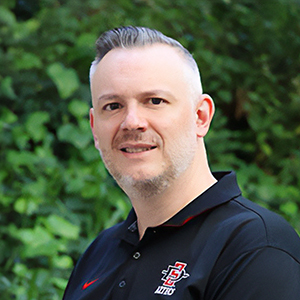
Gregory Holland, Ph.D.
Pronouns: Gregory
Professor of Analytical and Physical Chemistry
Department of Chemistry and Biochemistry
Analytical Chemistry, Physical Chemistry
College of Sciences
SDSU
Primary Email: [email protected]
Building/Location
Geology Mathematics Computer Science - 213C
5500 Campanile Dr
San Diego,
CA
92182
Mail Code: 1030
Website Links
Areas of Specialization
Analytical Chemistry, Physical Chemistry, Nuclear Magnetic Resonance
Courses
Chemistry 750: Special Topics in Analytical Chemistry: Practical NMR
Chemistry 695: Graduate Education in Chemistry
Chemistry 200/202: General Chemistry
Chemistry 100: General Chemistry
Chemistry 753: Analytical Spectroscopy
Chemistry 457: Instrumental Analysis.
Research
Research Lab
Research Focus
The Holland Lab investigates how molecular structure and dynamics give rise to material properties and biological function, with particular emphasis on structural proteins, biomolecular materials, and bio–nano interfaces.
Current Research Areas
Spider Silk and Structural Proteins
Elucidating the molecular mechanisms governing silk protein storage, liquid–liquid phase separation, supramolecular assembly, and fiber formation using solution NMR, solid-state NMR, scattering methods, and molecular dynamics simulations.
Bio–Nano Interfaces
Defining the atomic-level structure of peptides and proteins adsorbed on nanomaterials such as hydroxyapatite and silica, with the goal of establishing rigorous structural characterization standards for functionalized nanoparticles.
Biomolecular Self-Assembly and Soft Materials
Investigating disorder-to-order transitions, transient interactions, and emergent architectures in protein-based systems.
Experimental and Computational Approaches
While nuclear magnetic resonance (NMR) spectroscopy—both solution and solid-state—forms the core of the laboratory’s expertise, the group integrates multiple complementary approaches, including:
- Small- and Wide-Angle X-ray Scattering (SAXS/WAXS)
- Dynamic Light Scattering (DLS)
- Peptide synthesis and isotope labeling strategies
- Molecular dynamics simulations and multiscale modeling
By combining spectroscopy, scattering, synthesis, and simulation, the laboratory connects atomic-scale structure to mesoscale organization and macroscopic material performance.
Training and Broader Impact
Dr. Holland mentors undergraduate researchers, M.S. and Ph.D. students, postdoctoral scholars (currently two), and high school trainees through programs such as the Army Educational Outreach Program (AEOP). His laboratory provides interdisciplinary training in advanced spectroscopy, molecular modeling, biomaterials research, and nanoscience, preparing trainees for careers in academia, industry, and national laboratories.
The Holland Lab collaborates extensively with researchers at SDSU, national laboratories, and international institutions. Research in the laboratory is supported by federal agencies including the Department of Defense (AFOSR, ARO) and the National Science Foundation. The work advances molecular-level materials design while contributing to workforce development in STEM fields.