
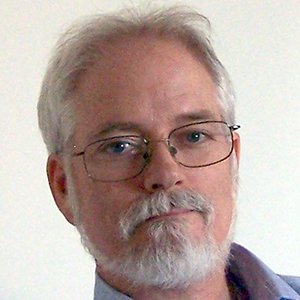
Andrew Cooksy, Ph.D.
Pronouns: he, him
Professor, Chemical Physics | Associate Director, Computational Sciences Research Center
Department of Chemistry and Biochemistry
Physical Chemistry
College of Sciences
SDSU
Primary Email: [email protected]
Building/Location
Chemical Sciences Laboratory - 310
5500 Campanile Dr
San Diego,
CA
92182
Mail Code: 1030
Website Links
Bio
Our work focuses on reactive intermediates in combustion and interstellar chemistry, investigated through laser spectroscopy and computational quantum mechanics.
Areas of Specialization
Chemical Physics, Spectroscopic Theory, Chemical Catalysis, Organometallic Spectra, Reactivity
Research
Research Lab
Cooksy Group
Research Focus
Our work focuses on reactive intermediates in combustion and interstellar chemistry, as investigated by laser spectroscopy and computational quantum mechanics. Collaborative work has included studies of spectroscopic theory, chemical catalysis, and organometallic spectra and reactivity.
Molecular free radicals are crucial to the chemistry of combustion, the upper atmosphere, polymerization, and interstellar molecular clouds. We are interested in the physical and chemical properties of these molecules, particularly those containing conjugated π-electron systems, such as HC3O and C4H, because the delocalized orbitals can confer surprising vibrational dynamics and reactive properties to these systems.

High Resolution Spectroscopy of Free Radicals
In our experimental work, we search for new spectra of small hydrocarbon or related free radicals in the infrared regions of the spectrum in order to characterize these dynamic properties. Our mid-infrared quantum cascade laser spectrometer uses a 2-meter 20-pass White cell as the sample chamber. With this system we search for strong stretching transitions in the free radicals, and then probe the isomerization coordinate by examining hot band and combination band spectra to obtain measurements at high resolution of the interesting vibrational dynamics of these molecules. This work has been funded by the NSF (including one of the first NSF CAREER awards), Exxon, and the Petroleum Research Fund.


Computational Studies of Free Radical Structures and Dynamics
We are engaged in concurrent ab initio computational studies of these and larger molecules to investigate the relative stability of the competing structures, and their effect on the chemistry. These ab initio calculations guide the laboratory measurements of the energy level structure, geometry, and chemistry of these molecules, as well as offering information for the kinetic models of the highly complex chemical environments found in combustion and interstellar space.
Previous work in our group along these lines included studies of the mechanisms behind the elctrocyclic ring-closure of cyclopentadienyl radical (C5H5) and the vibrational dynamics of cyclooctatetraenyl (C8H7), including its effective isomerization from one structure to another under specific vibrational excitations.
Recognizing the need for a general, easily mastered way to study these complex vibrational dynamics, we have published a protocol for the integration of the vibrational Schrödinger equation on an arbitrary potential energy surface. This work formed the doctoral work of Dong Xu, one of SDSU's first two PhD students in Computational Sciences and now a professor at Idaho State University. PhD student Peter Zajac, now CEO at SurgLogs, extended that work by implementing periodic boundary conditions and a powerful interpolation engine, allowing users to input point-wise PES maps without first resorting to analytical fits.

Photophysics of Nucleobases and Organometallics
We have been collaborating with Prof. Byron Purse to better understand the physics of high-quantum-yield nucleobase analogs developed in his laboratory. In addition, we have been contributing to several studies by Prof. Hani Amouri of the CNRS (Centre National de la Recherche Scientifique) in Paris. Prof. Amouri assembles organometallic complexes, often with two or more metal atoms, in a search for novel optoelectronic materials and nanostructures. Our work has supported the interpretation of spectroscopic and x-ray data by modeling characteristics of the molecular orbitals and intramolecular interactions.
We gratefully acknowledge funding for past and current work from the Army Research Office, the National Science Foundation, the Petroleum Research Fund of the American Chemical Society, the Exxon Education Foundation, and the San Diego Foundation.