
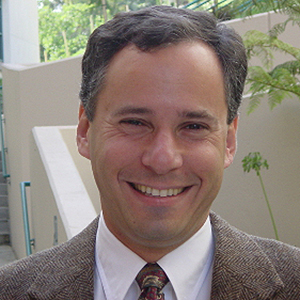
David Pullman, Ph.D.
Pronouns: David
Associate Professor of Physical Chemistry
Department of Chemistry and Biochemistry
Physical Chemistry
College of Sciences
SDSU
Primary Email: [email protected]
Building/Location
Chemical Sciences Laboratory - 301
5500 Campanile Dr
San Diego,
CA
92182
Mail Code: 1030
Bio
The emphasis of research in the Pullman lab is on the synthesis, structural and kinetic characterization, and manipulation of metal nanoparticles. Much of our work involves silver nanoparticles, which are now the most commercially prevalent nanoparticles on the market, due to their antimicrobial activity as well as their remarkable optical properties. We are predominantly an experimental group, but when needed, we use an integrated approach in which computational and theoretical studies help in guiding and then interpreting the experiments. Examples of current nanoparticle projects include the catalytic production of silver nanoparticles, synthesis of chemically stable and photostable silver nanoparticles for application in plasmonic devices, mechanism of production of citrate-capped silver nanoparticles via reduction of silver ions by NaBH4, catalysis of chemical reactions on silver nanoparticle surfaces, tuning of the antibacterial activity of silver nanoparticles via surface modification, kinetics of halide-induced decomposition and aggregation of silver nanoparticles, and adsorption kinetics of amino acids and proteins. We rely on a number of complementary experimental techniques to characterize the nanoparticle systems: Optical spectroscopies (UV-visible-nearIR, Raman, and IR), transmission electron microscopy, atomic force microscopy, NMR, inductively coupled plasma mass spectrometry (ICP-MS), and electrospray ionization mass spectrometry. We also modify or construct instruments when needed, enabling us to expand on the types of possible experiments. Electronic structure computations in support of the experimental work are carried out on the Molecular Sciences Computer Cluster. We also study the kinetics and dynamics of chemical reactions that take place on well-defined crystalline surfaces. In this work, we utilize ultrahigh vacuum techniques to prepare and characterize samples, which are subsequently probed using sensitive analytical techniques, including molecular beam scattering, angle-resolved thermal desorption spectroscopy, Auger spectroscopy, and mass spectroscopy. Our principal work in this area has been in elucidating the mechanism of reactions involving hydrogen on the Si(100) surface. An example is the discovery of an exceptionally high kinetic order, roughly 9, for the recombinative desorption of molecular hydrogen from Si(100) surfaces that were previously saturated with atomic hydrogen. This order is among the highest ever measured for any chemical reaction. It is an apparent order, and interestingly, our data suggest it arises from two competing low-order desorption processes. Our final area of investigation, inspired by experiments in our group, is to develop a detailed understanding of the origin of contrast in scanning tunneling microscope images of graphite and few-layer graphene. Although this has been considered a solved problem, persistent discrepancies between experiment and theory led us to revisit this issue. Using periodic density functional theory, we are exploring the possibility that defects of various types may account for the prominent asymmetric features often seen in experiments. This work is done in collaboration with Dra. Maria Guadalupe Moreno Armenta of the Centro de Nanociencias y Nanotecnología, Universidad Nacional Autónoma de México in Ensenada.
Areas of Specialization
Physical Chemistry
Research
Research Lab
Pullman Lab
Research Focus
- Catalytic production of silver nanoparticles
- Synthesis of chemically stable and photostable silver nanoparticles for application in plasmonic devices
- Mechanism of production of citrate-capped silver nanoparticles via reduction of silver ions by NaBH4
- Catalysis of chemical reactions on silver nanoparticle surfaces
- Tuning of the antibacterial activity of silver nanoparticles via surface modification
- Kinetics of halide-induced decomposition and aggregation of silver nanoparticles
- Adsorption kinetics of amino acids and proteins